Physics uses basic models to simplify complex systems.
A common model is the particle.
Particles are point-like objects with no internal structure, just properties like mass and velocity.
More complicated properties like rotation, and friction are often ignored.
We've used the particle model to understand phenomena like:
momentum,
gravitation,
Coulomb's law,
and current.
Another commonly used model is the wave.
Waves are different from the particle model in some interesting ways.
They don't exist at a point. They spread out in every direction at a constant speed.
They have zero mass, and they can overlap with each other without interacting.
Click the image to make a two dimensional wave.
A wave is produced when a medium is disrupted.
The wave is the disruption spreading through the medium.
The nature of each medium gives waves different properties.
If you throw a pebble into a pond you see a wave spread out along the surface of the water.
When a tree falls in the forest you can hear the sound waves spread out through the air.
When you look at the sky you see electro-magnetic waves made by stars.
When a wave propagates, what is moving is energy, not matter.
The speed of propagation is determined by the medium.
Properties like frequency, amplitude, or wavelength generally don't affect the speed.
A wave is a disturbance that propagates through a medium.
Click the underlined words for their definition.
Each type of wave has a different mechanism of propagation. The speed and possibility of a wave propagating through a medium is different for each wave type.
speed (m/s)
vacuum
air
water
glass
sound
N/A
340
1484
4540
light
299 792 458
299 700 000
225 000 000
200 000 000
Soundtravels faster in dense media because the atoms are closer together. This means the atoms don't have to move as far to collide.
A light wave is slower in dense media because as the light wave propagates through a medium it produces ripples that interfere in a way that slows the group velocity of the light wave.
Example: Two students are holding a slinky while standing 3.6 m apart. The first student sends a pulse which travels all the way down and back again. It takes 2.4 s for the wave to return. What is the speed of the wave?
solution
$$v = \frac{\Delta x}{\Delta t}$$
$$v = \frac{3.6 \, \mathrm{m}\times 2}{2.4\, \mathrm{s}} $$
$$v = 3 \, \mathrm{\tfrac{m}{s}}$$
Investigation: Can you figure out what factors affect the speed of a string wave? Go experiment with a string, or slinky to find out.
results Tension is probably the easiest way to control the speed of a string wave. The equation below shows that string mass and length are also factors.
$$ v = \sqrt{\frac{T}{\tfrac{m}{L}}}$$
v = velocity (m/s)
T = tension (N)
m = mass (kg)
L = string length (m)
Changing wave speed is used to change the pitch of stringed instruments. Notes from a guitar or harp are changed through tension, length, or string mass.
How Waves Propagate
Propagate is the word we use to describe waves moving. We try not to say move, because waves are a disturbance transmitting through the medium. The medium doesn't move. Each medium has their own mechanism of propagation, but they share some common principles.
A medium at rest is in equilibrium; the forces are in balance. A disruption spreads through a medium bringing it out of equilibrium.
Soundwaves are vibrations that propagate through matter. They are produced by changes in pressure and velocity. Your earsenses the amplitude and frequency of the vibrations.
Each time you click these simulations you will send a pulse of compressed particles, sound!
I've graphed the density and highlighted the particles with higher speeds. You can see the wave trading between kinetic energy and pressure.
Waves don't transmit matter, just energy. In the simulation above one particle is highlighted. Watch how it oscillates when it becomes part of the wave, but over time it stays in the same area.
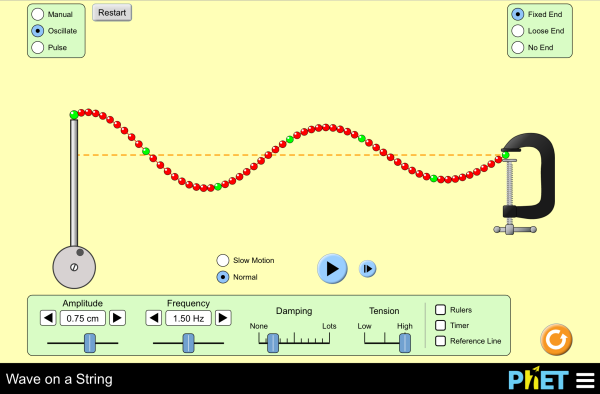
Sound waves oscillate parallel to propagation, but most waves oscillate perpendicular to propagation.
Longitudinal Wave = The medium oscillates parallel to the direction of wave propagation.
Examples: sound, slinky
Transverse Wave = The medium oscillates perpendicular to the direction of wave propagation.
Examples: light, string, slinky, sound (in solids), gravity
Click to Run
Periodic Waves
Waves that repeat are called periodic.
Periodic waves have these measurable properties.
Period, T = time for one complete wave cycle to pass a point [s]
Frequency, f = number of cycles that pass per second [Hz, 1/s]
Wavelength, λ = distance over which a wave's shape repeats [m]
Phase, ϕ = fraction of a repeating cycle for point on the wave [0,2π] or [0,360]
Waves can have different shapes. The waveform below is a
wave.
max amplitude =
m
velocity =
m/s
wavelength =
m
Graphing: Let's see if we can find a relationship between frequency and period.
Change the wavelength and record about five different pairs of frequency and period.
Graph the pairs with period as the x-coordinate and frequency as the y-coordinate.
What does the graph look like?
result
It's an inverse function.
$$f = \frac{1}{T}$$
\(f\) = frequency [Hz, 1/s, hertz]
How often an event happens in a second.
\(T\) = time period [s, seconds]
How many seconds are between each event.
Example: An air horn sounds at a frequency of 220 Hz. How many seconds pass between each wave crest?
solution
$$T = \frac{1}{f}$$
$$T = \frac{1}{220 \, \mathrm{Hz}}$$
$$T = 0.0045 \, \mathrm{s}$$
Example: The Los Angeles Metro Expo Line has a train arrive at 6:50am, 6:56am, and 7:02am. What is the period and frequency of the trains?
solution
$$6:56-6:50 = 6\, \mathrm{min}$$
$$T = 6\, \mathrm{min} \left(\frac{60\, \mathrm{s}}{1\, \mathrm{min}}\right) = 360\, \mathrm{s}$$
$$f = \frac{1}{T}$$
$$f = \frac{1}{360 \, \mathrm{s}}$$ $$f=0.0027 \, \mathrm{Hz}$$
Click the circle to start. Click again to pause if it gets annoying.
Question: Which slider controls period and which controls frequency?
answer
Period is controlled by the left slider and frequency by the right.
Example:Red light has a frequency of 450 THz. What is its period?
table of metric prefixes
For periodic waves, the product of the frequency and wavelength is equal to the wave's velocity.
$$v = f \lambda \quad \quad v = \frac{\lambda}{T} $$
\(v\) = propagation speed [m/s]
\(\lambda\) = wavelength [m, meters]
\(f\) = frequency [Hz, 1/s, hertz]
\(T\) = time period [s, seconds]
Example: If I triple the wavelength of a sound wave while keeping the wave speed the same, what happens to the frequency?
solution
$${ \atop v} {\atop =} { \Downarrow \atop f} { \Uparrow \atop \lambda} $$
$$v=\left(\tfrac{1}{3} f \right) (3 \lambda) $$
λ and f are inversely proportional, and v is constant.
Tripling λ will reduce f by a factor of one third.
frequency =
Hz
Example: Click to hear a wave. Calculate the length of the sound wave at the frequency you hear for both air and water.
table of wave speeds
speed (m/s)
vacuum
air
water
glass
sound
N/A
340
1484
4540
light
299 792 458
299 700 000
220 000 000
200 000 000
solution
$$\text{air}$$
$$v = f \lambda$$
$$\lambda = \frac{v}{f}$$
$$\text{water}$$
$$v = f \lambda$$
$$\lambda = \frac{v}{f}$$
Example: A cell phone sends and receives light in the microwave range, at wavelengths around 1 cm. How many cycles pass through the phone in one second?
solution
Example: As a wave enters a new medium its speed decreases.
The frequency of the wave stays the same, but how does the wavelength change?
solution
$$v = f \lambda $$
v and λ are directly proportional. This means decreasing v will decrease λ.
Example: AC (alternating current) electricity in the U.S. has a frequency of 60 Hz. In most other countries it is 50 Hz. An electrical signal propagates through a wire at about 2/3 the speed of light. What is the wavelength for an AC wave in the United States?
solution
$$v = f \lambda$$
$$\lambda = \frac{v}{f} $$
$$\lambda = \frac{(\tfrac{2}{3})(3.0 \times 10^8)}{60} $$
$$\lambda = \frac{2.0 \times 10^8}{60} $$
$$\lambda = 0.033 \times 10^8 \, \mathrm{m} $$
$$\lambda = 3300\, \mathrm{km} $$
Example:Gravity waves are ripples in spacetime that propagate at the speed of light. The first detected gravity wave was on 11 February 2016 when the LIGO and Virgo Scientific Collaboration observed gravitational waves originating from a pair of merging black holes. If you convert the gravity wave into a sound wave you can hear a chirp.
How big are gravity waves? Over the 0.2 second detection, the frequency increased from 35 Hz to 250 Hz. Calculate the starting and ending wavelength.
solution
$$ v = 3 \times 10^{8} \, \mathrm{\tfrac{m}{s} }$$
$$v = f \lambda$$
$$\lambda = \frac{v}{f}$$
The wavelength ranged from 8500 km to 1200 km. We can also find the length of the entire signal.
$$v = \frac{\Delta x}{\Delta t}$$
$$\Delta x = v\Delta t$$
$$\Delta x = (3 \times 10^{8}) (0.2)$$
$$\Delta x = 0.6 \times 10^{8} \, \mathrm{m}$$
The entire signal was 60 000 000 m long. That's about 5 Earths long.
Reflection and Refraction
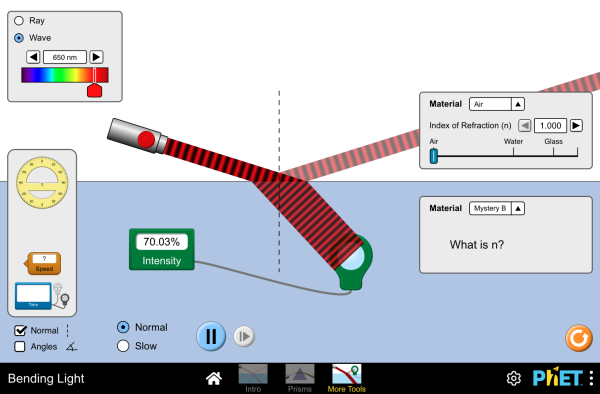
Reflection and refraction occur when the wave speed changes as it enters a new medium. Part of the wave refracts into the new medium, and part of the wave reflects back into the old medium.
Refraction = After entering a new medium, a wave will change its direction of propagation. This occurs because different media have different speeds.
When slowing down, the wave will bend towards the normal.
When speeding up, the wave will bend away from the normal.
Reflection = When hitting a new medium, part of a wave stays in the original medium. The angle between the incident ray and the normal line equals the angle between the reflected ray and the normal.
$$\theta_i = \theta_r$$
Most substances are bumpy at the molecular level. Because of the bumpiness, they scatter reflected light in many directions. Scattered light is called diffuse light. Materials like dirt, skin, and wallpaper reflect diffuse light.
Smooth materials produce a clear mirror image, called a specular reflection.
Specular reflections are found in materials like metal, glass, and water.
Mirrors are typically made by coating one side of a plate of glass with metal.
Example: How will the light ray bend as it enters the denser media? Complete the path of light in the diagram above.
solution
It will refract up, towards the normal.
Click to Run
Simulation: Can you figure out how to produce total internal reflection? This is when the light only reflects and doesn't refract.
answer
Total internal reflection occurs when the light starts in the slower medium and hits the faster medium at a small angle.
Simulation: Different frequencies refract different amounts. This phenomenon is called dispersion. How does refraction work differently for high vs. low frequency? Test it out in the simulation.
answer
The wavelength/color/frequency of the light changes the angle of refraction. A blue light has a shorter wavelength and it will refract more.
Light slows down in dense media. As a gas increases in temperature, it expands and becomes less dense.
This allows light to speed up when it enters a hot pocket of gas.
As light changes speed it will refract and bend.
This phenomenon produces a mirage effect when you look down a hot road.
Here are some examples of reflection and refraction in a 2-D ripple tank:
Example: Light enters air from glass at 36.0º to the normal. This glass has an index of 1.52. What angle does the light leave relative to the normal?
solution
As the light wave enters a new medium some of the light is reflected, and some is refracted.
If the angle of refraction is 90º or higher, the light will only reflect.
This is calledtotal internal reflection.
The angle of incidence that produces a 90º angle of refraction is called the critical angle.
You can see total internal reflection if you swim under some water and look upwards.
Example: A 600 nm wave of red light starts in water and enters air. What is the critical angle for total internal reflection?
strategy
Look up the index of refraction for air and water.
Set the angle of refraction to 90º.
Solve for the angle of incidence.