Isaac Newton(1643-1727) made many profound contributions to science.
He was an important figure in the Scientific Revolution.
He worked on optics.
He discovered universal gravitation.
He also shares credit for inventing calculus.
In his work Philosophiæ Naturalis Principia Mathematica, Newton formulated his three laws of motion that model how objects accelerate.
These laws make up the foundation of classical physics.
Hypothesis, Theory and Law
Science doesn't produce unchanging truths.
Science is an ongoing process of discovery, and each new explanation has the potential to improve on the previous.
Hypotheses, theories and laws could be true, but it is impossible to know anything with 100% certainty.
A phenomenon is an observable event, like the orbits of planets, static electricity, and lactose intolerance.
A hypothesis is a possible explanation for a phenomenon.
A scientific theory is a hypothesis that has been tested many times and never been proven false.
Theories are explanations. They answer the question: why does this phenomenon occur?
Examples include: quantum field theory, big bang theory, evolution, and germ theory.
A scientific law is also based on the results of many tests, but a law doesn't explain why a phenomenon occurs.
Instead, laws are a general description of what has happened and what will happen for a narrow range of conditions.
Laws predict the behavior of a natural phenomenon.
Laws are only accurate for a limited range of conditions.
Laws are typically a mathematical equation, or a rule.
Almost all laws are found in the physical sciences.
Some examples are: Ohm's Law, Universal Gravitation, Coulomb's law, and Kirchhoff's laws.
Question: Why are scientific laws so rare in the life sciences?
answer
Most biological phenomenon are too complex to be explained by math.
After observing the motion of the planets, Nicolaus Copernicus published the idea that the planets revolved around the sun.
This idea was tested many times and never disproven.
Sixty years later, Johannes Kepler discovered an equation that predicted how the planets moved around the sun.
Question: Identify a phenomenon, hypothesis, theory, and law from the paragraph above.
answer
phenomenon: the motion of the planets
hypothesis: planets revolve around the sun
theory: planets revolve around the sun
law: Kepler's equation
Question: What about a scientific model? What does that word mean?
answer
A scientific model is a simplified representation of an aspect of reality.
Models help us learn new things, predict how a complex system behaves, or guide future research.
Models in physics often take the form of an equation, but they can also be a set of rules, or a physical thing.
Generally, it is clear that a model doesn't match reality, but if the inaccuracy is small a model still has value.
"A body either remains at rest or continues to move at a constant velocity, unless acted upon by a net external force."
All matter has the property of Inertia.
Matter stays still or keeps moving until a force causes it to accelerate.
Most people already have a strong intuitive understanding of inertia.
You probably know it's difficult to move something very heavy and easy to move something light.
That's inertia.
The Earth has orbited the Sun for billions of years without coming to a stop.
It's clear that objects in space follow Newton's first law.
Question: Objects on Earth seem to not follow Newton's first law. What causes objects on Earth to always come to a stop?
answer
The force of friction slows things down.
As air particles strike a fast moving object the object slows down and the air speeds up.
This spreads out the movement, but the movement is still there.
Press E to simulate the mass. Then press WASD to apply forces to the mass. Imagine the screen is the floor and you are looking down on the mass as it slides around, like air hockey.
Simulation: What causes the mass to stop when you aren't pressing a key?
observation
Objects only change velocity if there is a force. In this case friction applies a force in the direction opposite the mass's velocity.
Newton's Second Law: Force
"The vector sum of the external forces F on an object is equal to the mass m of that object multiplied by the acceleration vector of the object."
Newton's second law defined a new term called force.
A body accelerates in the direction of the sum of the forces applied to it.
The mass of the body determines how much acceleration is felt.
$$\sum F=ma$$
\( F \) = force [N, Newtons, kg m/s²] vector a push or a pull
\(m\) = mass [kg, kilogram]
resistance to acceleration
\(a\) = acceleration [m/s²] vector
\( \sum \) = The greek letter Sigma represents a summation of numbers. It means add up all the forces to get a net force.
$$\sum F=F_{1}+F_{2}+F_{3}+...$$
If there was a 5 N force to the left and a 20 N force to the right we could get the net force by adding them. Force is a vector, so the left force should be negative.
Example: A ball has a mass of 0.43 kg. Find the acceleration of the ball when it experiences a net force (total force) of 1 N from air friction.
solution
Example: A 100 kg boat at rest is being pushed left with a 2000 N force from the wind. The water current is producing a force of 1900 N to the right. How will the boat accelerate? How far will the boat go in 6 s?
solution
$$ \text{Vectors pointed down or left are negative.}$$
$$\sum F=ma$$ $$-2000+1900=(100)(a)$$
$$-100=(100)(a)$$
$$-1 \mathrm{\tfrac{m}{s^{2}}}= a$$
$$ \text{The boat will accelerate to the left.}$$ $$ u = 0 $$ $$ \Delta x = ?$$ $$ \Delta t = 6\mathrm{s}$$
$$ \Delta x = u\Delta t+ \tfrac{1}{2} a \Delta t^{2}$$
$$ \Delta x = (0)(6)+\tfrac{1}{2} (-1)(6)^{2}$$
$$ \Delta x = \tfrac{1}{2} (-1)(6)^{2}$$
$$ \Delta x = -18 \, \mathrm{m}$$
$$ \text{The boat will move 18 meters to the left.}$$
Play around with the net force simulation to get a feeling for how adding force vectors produces acceleration.
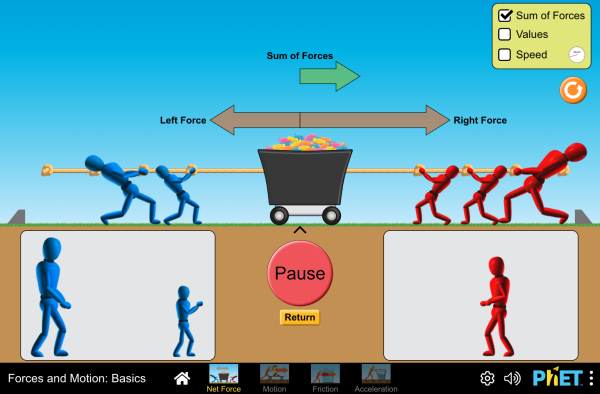
Click to Run
Question: Could the tug of war be moving left, but have a net force to the right?
answer
An object could be moving in one direction and have a force in the opposite direction if it was slowing down.
To test this out, add one person to the left. Click go. Wait a second. Add two on the right.
Question: On the motion mode, find the mass of the gift.
answer
We need to solve a 1-D motion problem with constant accelerate. We can record the initial and final velocities if you check the "values" and "speed" boxes. Get a stopwatch to record the time elapsed.
After we use a kinematics equation to solve for acceleration, we can use Newton's 2nd law to calculate the mass.
answer
I applied a 10N force for 10 seconds and recorded the time and velocities.
Force and acceleration are directly proportional.
Increasing F will cause a proportional increase in a.
Question: If I apply a 100 N force to a mass it accelerates at 2 m/s².
What happens if I double the mass while keeping the force the same?
answer
Force is constant so we can just pretend it is one.
$$F=ma$$
$$1=ma$$
$$1=(2m)\left(\tfrac{1}{2} a \right)$$
Mass and acceleration are inversely proportional.
Doubling m will cause a to be halved.
Newton's Third Law:
Equal and Opposite Force Pairs
"When one body exerts a force on a second body, the second body simultaneously exerts a force equal in magnitude and opposite in direction on the first body."
$$F_1 = -F_2$$
If you push on something it will push back with the same force, but in the opposite direction. Forces always come in equal, but opposite pairs.
Most of the time force pairs come from objects in contact, but even non-contact forces, like gravity, still obey this law.
Question: You push down on the ground with a 1000 N force. Describe the magnitude and direction of the force the ground pushes on you.
answer
The force the ground applies is equal and opposite to the force you apply on the ground. The magnitude is 1000 N. The direction is up.
Question: A boxer's glove applies a 140 N force to the face of another boxer. Describe the magnitude of the force the face applies to the glove.
answer
When a fist is punching a face, the face is also punching the fist. That's deep...
Anyways, the force is equal and opposite. The magnitude is 140 N.
Example: You (100 kg) are standing on a frictionless skateboard. You throw your 2 kg bottle of water to the right. During the throw, the water bottle briefly accelerates at 40 m/s². How much acceleration do you feel at that time?
strategy
Calculate the force the water bottle feels when it accelerates at 40 m/s². Plug the negative value of that force in as the force you feel.
solution
The force the water bottle feels is equal and opposite to the force you feel.
In case you wanted more practice I used AI to make some more problems. The rest of the site I made by hand, but generating endless problems seemed safe. I did find mistakes in the AI generated problems, and there are probably some I didn't find. Let me know if something could be fixed. I also added a practice problem on each page with no solution. That's intentional. Have fun!
Keep left and down negative unless the problem gives a different direction.
Example: An 8 kg crate of lab supplies is pushed right with a 30 N force. Friction pushes left with a 6 N force, and the crate's label says fragile. What is the crate's acceleration?
solution
Let right be positive.
$$\sum F = 30\,\mathrm{N} - 6\,\mathrm{N}$$
$$\sum F = 24\,\mathrm{N}$$
$$\sum F=ma$$
$$a=\frac{\sum F}{m}$$
$$a=\frac{24\,\mathrm{N}}{8\,\mathrm{kg}}$$
$$a=3\,\mathrm{m/s^2}$$
The crate accelerates to the right.
Example: A 4 kg cart starts from rest on a level track. A net force of 10 N pushes it to the right for 0.050 min while a student records video from the side. What is its acceleration, and how far does it move?
solution
$$0.050\,\mathrm{min}=3.0\,\mathrm{s}$$
$$\sum F=ma$$
$$a=\frac{\sum F}{m}$$
$$a=\frac{10\,\mathrm{N}}{4\,\mathrm{kg}}$$
$$a=2.5\,\mathrm{m/s^2}$$
Now use the acceleration to find the motion from rest.
$$\Delta x=u\Delta t+\tfrac{1}{2}a\Delta t^2$$
$$\Delta x=(0)(3.0)+\tfrac{1}{2}(2.5)(3.0)^2$$
$$\Delta x=11.25\,\mathrm{m}$$
Example: What is the weight of a 65 000 g person near Earth's surface?
solution
Weight is the force of gravity.
$$65\,000\,\mathrm{g}=65\,\mathrm{kg}$$
$$F_g=mg$$
$$F_g=(65\,\mathrm{kg})(9.8\,\mathrm{m/s^2})$$
$$F_g=637\,\mathrm{N}$$
Example: Two students pull a 15 kg cart. One pulls left with 40 N and the other pulls right with 40 N. What is the cart's acceleration?
solution
Let right be positive.
$$\sum F=40\,\mathrm{N}-40\,\mathrm{N}$$
$$\sum F=0\,\mathrm{N}$$
$$\sum F=ma$$
$$0=(15\,\mathrm{kg})a$$
$$a=0\,\mathrm{m/s^2}$$
Balanced forces do not cause acceleration.
Example: A net force of 72 N makes a cart accelerate at 3 m/s². What is the mass of the cart?
solution
$$\sum F=ma$$
$$m=\frac{\sum F}{a}$$
$$m=\frac{72\,\mathrm{N}}{3\,\mathrm{m/s^2}}$$
$$m=24\,\mathrm{kg}$$
Example: A 12 kg crate is pushed with a 40 N force across a rough floor. What is its acceleration?
answer
This cannot be solved from the information given. Newton's second law needs the net force, and the rough floor means friction may also act. The friction force is missing.
Example: A 12 kg sled accelerates right at 2 m/s². Friction pushes left with 5 N. What applied force to the right is needed?
solution
First find the net force needed.
$$\sum F=ma$$
$$\sum F=(12\,\mathrm{kg})(2\,\mathrm{m/s^2})$$
$$\sum F=24\,\mathrm{N}$$
The applied force must beat friction and still leave 24 N to the right.
$$F_{\mathrm{applied}}-5\,\mathrm{N}=24\,\mathrm{N}$$
$$F_{\mathrm{applied}}=29\,\mathrm{N}$$
Example: A 60 kg canoe drifts near a dock. The water current pushes it right with 0.140 kN, and wind pushes it left with 0.200 kN. The canoe is 4.5 m long, but model it as one object. What is the canoe's acceleration?
solution
Let right be positive.
$$0.140\,\mathrm{kN}=140\,\mathrm{N}$$
$$0.200\,\mathrm{kN}=200\,\mathrm{N}$$
$$\sum F=140\,\mathrm{N}-200\,\mathrm{N}$$
$$\sum F=-60\,\mathrm{N}$$
$$a=\frac{\sum F}{m}$$
$$a=\frac{-60\,\mathrm{N}}{60\,\mathrm{kg}}$$
$$a=-1\,\mathrm{m/s^2}$$
The canoe accelerates left.
Example: A 3 kg drone has a 30 N force to the right. It accelerates left at 4 m/s². What leftward force must also be acting on it?
solution
Let right be positive, so the acceleration is negative.
$$\sum F=ma$$
$$\sum F=(3\,\mathrm{kg})(-4\,\mathrm{m/s^2})$$
$$\sum F=-12\,\mathrm{N}$$
Let the unknown leftward force be F left.
$$30\,\mathrm{N}-F_{\mathrm{left}}=-12\,\mathrm{N}$$
$$F_{\mathrm{left}}=42\,\mathrm{N}$$
Example: A 500 g ball accelerates to the right at 30 m/s² while a student throws it. What force does the student apply to the ball?
solution
$$500\,\mathrm{g}=0.50\,\mathrm{kg}$$
$$\sum F=ma$$
$$\sum F=(0.50\,\mathrm{kg})(30\,\mathrm{m/s^2})$$
$$\sum F=15\,\mathrm{N}$$
The student applies a 15 N force to the right on the ball.
Example: In the previous example, what force does the ball apply to the student's hand?
solution
Newton's third law says force pairs are equal in magnitude and opposite in direction.
$$F_{\text{student on ball}} = 15\,\mathrm{N}\ \text{right}$$
$$F_{\text{ball on student}} = 15\,\mathrm{N}\ \text{left}$$
The ball pushes back on the student's hand with 15 N to the left.
Example: Two ice skaters push off each other. Skater A has a mass of 60 kg, skater B has a mass of 45 kg, and each feels a 90 N force during the push. What is each skater's acceleration?
solution
The forces are equal in size, but each skater has a different mass.
$$a_A=\frac{\sum F}{m_A}$$
$$a_A=\frac{90\,\mathrm{N}}{60\,\mathrm{kg}}$$
$$a_A=1.5\,\mathrm{m/s^2}$$
$$a_B=\frac{\sum F}{m_B}$$
$$a_B=\frac{90\,\mathrm{N}}{45\,\mathrm{kg}}$$
$$a_B=2.0\,\mathrm{m/s^2}$$
The accelerations are in opposite directions.
Example: A 75 kg person pushes a 5 kg box. The box accelerates right at 6 m/s². If the only horizontal force on the box is the push, what acceleration does the person feel from the box's push back?
solution
First find the force on the box.
$$F=ma$$
$$F=(5\,\mathrm{kg})(6\,\mathrm{m/s^2})$$
$$F=30\,\mathrm{N}$$
The box pushes back on the person with 30 N in the opposite direction.
$$a=\frac{\sum F}{m}$$
$$a=\frac{-30\,\mathrm{N}}{75\,\mathrm{kg}}$$
$$a=-0.40\,\mathrm{m/s^2}$$
Example: A 12 kg backpack is dropped near Earth's surface. What is its weight, and what acceleration would it have if gravity were the only force on it?
solution
First find the weight.
$$F_g=mg$$
$$F_g=(12\,\mathrm{kg})(9.8\,\mathrm{m/s^2})$$
$$F_g=117.6\,\mathrm{N}$$
If gravity is the only force, then the net force is the weight.
$$a=\frac{\sum F}{m}$$
$$a=\frac{117.6\,\mathrm{N}}{12\,\mathrm{kg}}$$
$$a=9.8\,\mathrm{m/s^2}$$
The acceleration is downward.
Example: A 900 kg car has a 3.2 kN engine force forward and 0.80 kN of resistive forces backward. What is the car's acceleration?
solution
Let forward be positive.
$$3.2\,\mathrm{kN}=3200\,\mathrm{N}$$
$$0.80\,\mathrm{kN}=800\,\mathrm{N}$$
$$\sum F=3200\,\mathrm{N}-800\,\mathrm{N}$$
$$\sum F=2400\,\mathrm{N}$$
$$a=\frac{\sum F}{m}$$
$$a=\frac{2400\,\mathrm{N}}{900\,\mathrm{kg}}$$
$$a=2.67\,\mathrm{m/s^2}$$
Example: A 10 000 g cart accelerates at 2 m/s² when a certain net force acts on it. If the same net force acts on a 25 000 g cart, what is the new acceleration?
solution
First convert both masses to kilograms.
$$10\,000\,\mathrm{g}=10\,\mathrm{kg}$$
$$25\,000\,\mathrm{g}=25\,\mathrm{kg}$$
First find the net force from the first cart.
$$\sum F=ma$$
$$\sum F=(10\,\mathrm{kg})(2\,\mathrm{m/s^2})$$
$$\sum F=20\,\mathrm{N}$$
Now use the same net force on the 25 kg cart.
$$a=\frac{\sum F}{m}$$
$$a=\frac{20\,\mathrm{N}}{25\,\mathrm{kg}}$$
$$a=0.80\,\mathrm{m/s^2}$$
What did Aristotle predict about a heavy object and a light object falling from the same height, and what did the Apollo 15 demonstration show instead?
answer
Aristotle predicted that the heavier object would fall faster. On the airless Moon, the hammer and feather landed together because they had the same gravitational acceleration.
A heavier object has a larger gravitational force on it. Why does that not make its free-fall acceleration larger in the simple model?
answer
The larger force is paired with a proportionally larger mass. In F = ma, using weight mg for the force leaves a = g, so the mass cancels.
Why can a rock and feather usually land at different times on Earth without disproving the Moon experiment?
answer
Air drag adds an upward force, and it matters much more for a light, wide feather than for a compact rock. The Moon has essentially no atmosphere, so that extra force is absent.
Reading (10 minutes): Read Cargo Cult Science by Richard Feynman from Caltech. Then answer these questions.
What does Feynman mean by "cargo cult science"?
answer
It is work that copies the visible form of science without producing reliable results. The key missing part is careful testing that can reveal when an idea is wrong.
What kind of scientific integrity does Feynman ask researchers to practice?
answer
He asks them to report possible mistakes, alternative explanations, and details that could weaken their conclusion. This gives other people a fair chance to check the work.
Why are repeated experiments important even when the original researcher believes their result is correct?
answer
Independent repetition can reveal an unnoticed error or show that the effect is real. Scientific confidence comes from nature continuing to agree with the evidence, not from one person's certainty.